npm:portkey-admin-mcp
Is the npm:portkey-admin-mcp MCP server safe to use?
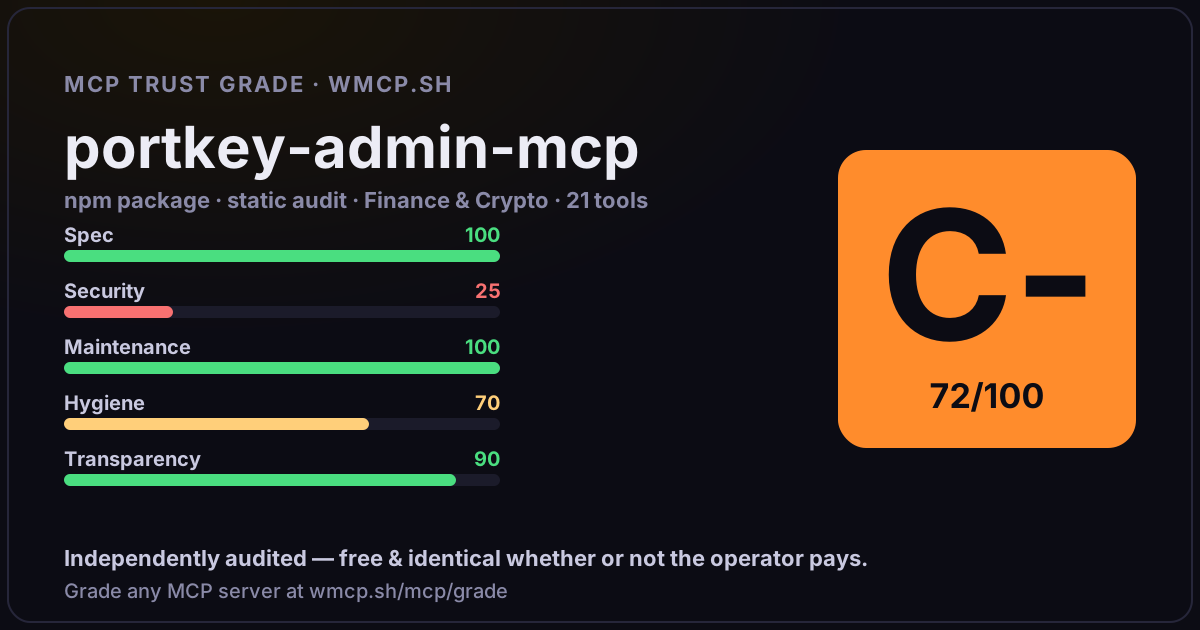
Independent trust grade C- (72/100). References sensitive file paths / environment secrets. wmcp.sh continuously watches npm:portkey-admin-mcp for tool drift and rug-pulls. The grade is free and identical whether or not the operator pays.
What it offers — 21 tools · Finance & Crypto
get_cost_analyticsGet cost time-series data with summary.total_cost, summary.average_cost_per_request, and per-bucket total/avg cost. Use this for spend analysis and sp
get_request_analyticsGet request-volume time-series data with summary.total_requests, summary.successful_requests, summary.failed_requests, and per-bucket total/success/fa
get_token_analyticsGet token-usage time-series data with summary.total_tokens, summary.prompt_tokens, summary.completion_tokens, and per-bucket total/prompt/completion c
get_latency_analyticsGet latency time-series data with summary.avg_latency_ms, summary.p50_latency_ms, summary.p90_latency_ms, summary.p99_latency_ms, and per-bucket laten
get_error_analyticsGet error-count time-series data with summary.total_errors and per-bucket counts. Use this for high-level error trends; use get_error_rate_analytics f
get_error_rate_analyticsGet error-rate time-series data with summary.error_rate_percent and per-bucket percentages of total requests. Use this for reliability and SLA trends;
get_cache_hit_latencyGet cache-hit-only latency time-series data with summary.total_latency, summary.avg_latency, and per-bucket total/avg latency. Use this to evaluate ca
get_cache_hit_rateGet cache-effectiveness time-series data with summary.hit_rate, summary.total_hits, summary.total_misses, and per-bucket hits/misses/rate. Use this to
get_users_analyticsGet user-growth time-series data with summary.total_active_users, summary.total_new_users, and per-bucket active/new user counts. Use this for growth
get_error_stacks_analyticsGet stacked error-series data grouped by HTTP status code over time, with summary and per-code series. Use this to see which error classes dominate; u
get_error_status_codes_analyticsGet HTTP error-code distribution time-series data with summary and per-code series. Use this to see which codes occur most often; use get_error_stacks
get_user_requests_analyticsGet per-user request-count time-series data with counts grouped by user. Use this to find heavy users and traffic concentration; use get_users_analyti
get_rescued_requests_analyticsGet rescued-request time-series data showing requests recovered by retry or fallback handling. Use this only when your configs include resilience feat
get_feedback_analyticsGet feedback-submission time-series data with summary totals and per-bucket counts. Use this as the top-level feedback trend view; use get_feedback_mo
get_feedback_models_analyticsGet feedback time-series data grouped by model, with per-model counts over time. Use this to compare feedback volume and satisfaction across models; u
get_feedback_scores_analyticsGet raw feedback-score distribution time-series data with per-score buckets. Use this to understand sentiment mix; use get_feedback_weighted_analytics
get_feedback_weighted_analyticsGet weighted feedback-score time-series data using the weight recorded at feedback creation. Use this for calibrated quality metrics; use get_feedback
get_analytics_group_usersGet a paginated per-user breakdown with total_groups, group_count, and a users array containing request count, cost, and token usage. Use this for bil
+3 more tools
- ✓ depends on an MCP SDK
- ✓ declares a bin entry (runnable server)
- ✓ 21 tool(s) detected in source
- ⚠ references sensitive file paths / env secrets
- scanned 2 source files
- published within 90 days
- 7 published versions
- no TypeScript types
- 7 runtime deps
- ✓ public repository linked
- ✓ MIT license
Findings
We re-grade npm:portkey-admin-mcp on a schedule and alert your Slack/webhook the moment its tools change or its grade drops — rug-pull insurance for the connection.
Share this report card
A 1200×630 card with the grade + audit — drop it in a post, Slack, or your repo.
Embed this grade
A live badge — it re-verifies itself and shows current stability. Static scorecards can't. Paste it in your README or site to show users you're independently audited.

[](https://wmcp.sh/mcp/grade/npm%3Aportkey-admin-mcp)
<a href="https://wmcp.sh/mcp/grade/npm%3Aportkey-admin-mcp"><img src="https://wmcp.sh/mcp/grade/npm%3Aportkey-admin-mcp/badge.svg" alt="MCP Trust Grade C- · wmcp.sh"></a>
Agents: check this before connecting
Add the wmcp.sh trust oracle as an MCP server and call grade_mcp_server / check_mcp_drift in your agent's pre-connection gate:
https://wmcp.sh/mcp/trust
readOnly vs observed behavior) layer on via the wmcp.sh proxy.