npm:@yawlabs/fetch-mcp
Is the npm:@yawlabs/fetch-mcp MCP server safe to use?
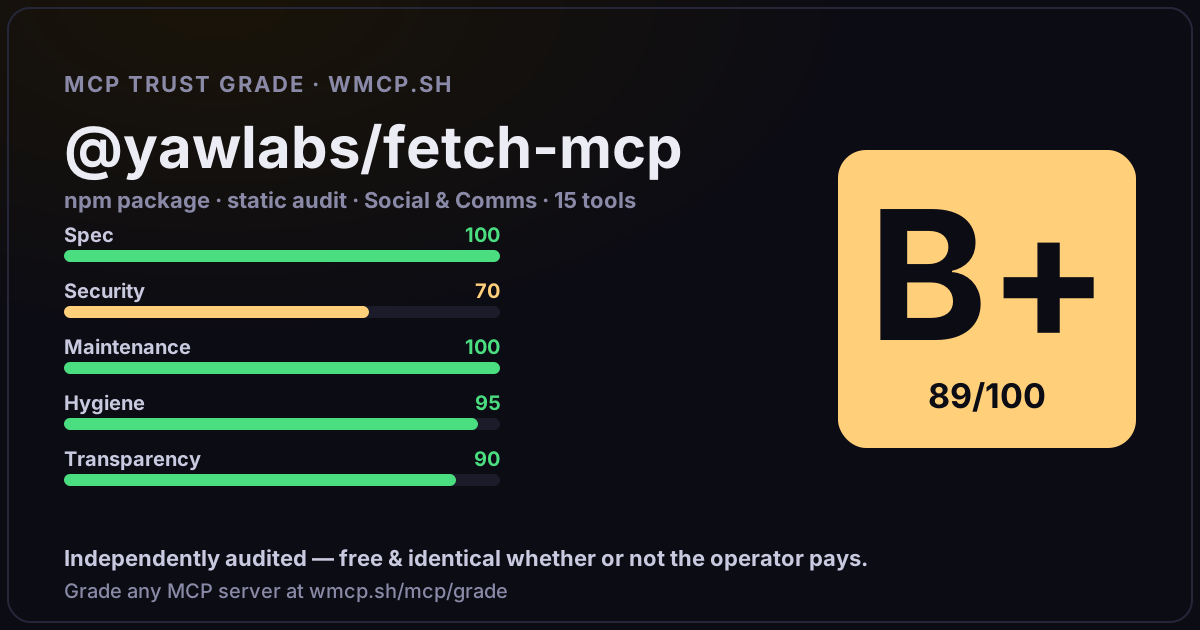
Independent trust grade B+ (89/100). Static analysis of npm package @yawlabs/fetch-mcp@0.3.4 (stdio server — no remote endpoint). Reliability/behavioral signals require running it; not measured. wmcp.sh continuously watches npm:@yawlabs/fetch-mcp for tool drift and rug-pulls. The grade is free and identical whether or not the operator pays.
What it offers — 15 tools · Social & Comms
fetch_html_to_markdownGET a URL, decode the HTML, and convert to clean markdown (headings, lists, links, code fences). Scripts, styles, iframes, nav, footer, and aside elem
fetch_html_to_textGET a URL, decode the HTML, and return plain text with block-level structure preserved as newlines. Scripts, styles, and comments stripped; HTML entit
fetch_feedFetch and parse an RSS 2.0 or Atom 1.0 feed. Returns feed-level metadata (title, description, link, updated) plus a list of entries (title, link, id,
http_getPerform an HTTP GET. Returns status, headers, and body. Automatically parses JSON when the server responds with application/json. Follows redirects (e
http_postPerform an HTTP POST. Body can be given as a raw string (body) or as a JSON value (body_json \u2014 auto-sets content-type to application/json). NOT i
http_putPerform an HTTP PUT. Use for full-resource replacement. Idempotent: the same PUT applied twice leaves the resource in the same state.
http_patchPerform an HTTP PATCH. Use for partial updates. Spec-wise NOT guaranteed idempotent \u2014 depends on the server
http_deletePerform an HTTP DELETE. Idempotent (per spec): a repeated DELETE on an already-deleted resource typically returns 404/410.
http_headPerform an HTTP HEAD. Returns status + headers with no body. Useful for checking a resource exists, getting its size (Content-Length), or polling for
http_optionsPerform an HTTP OPTIONS. Returns the server
fetch_linksExtract every outbound link from an HTML page, resolved to absolute URLs. Each entry includes href, anchor text, optional rel/title, and an internal/e
fetch_metaGET a URL and extract its head metadata: title, description, canonical, language, robots directive, Open Graph / Twitter Card / article: properties, i
fetch_readerGET a URL, locate the main article body (prefers <article>, <main>, itemprop=articleBody, or known CMS class names; falls back to <body>), strip navig
fetch_robotsFetch and parse the robots.txt for a given origin, then tell the caller whether a target URL is crawlable by a given user-agent. Follows the Google-st
fetch_sitemapFetch a sitemap.xml (or sitemap-index) and return the contained URLs with their lastmod / changefreq / priority. Follows sitemap-index chaining up to
- ✓ depends on an MCP SDK
- ✓ declares a bin entry (runnable server)
- ✓ 15 tool(s) detected in source
- uses eval/exec/child_process (review for unsanitized input)
- scanned 2 source files
- published within 90 days
- 7 published versions
- ✓ ships TypeScript types
- 5 runtime deps
- ✓ public repository linked
- ✓ MIT license
Findings
We re-grade npm:@yawlabs/fetch-mcp on a schedule and alert your Slack/webhook the moment its tools change or its grade drops — rug-pull insurance for the connection.
Share this report card
A 1200×630 card with the grade + audit — drop it in a post, Slack, or your repo.
Embed this grade
A live badge — it re-verifies itself and shows current stability. Static scorecards can't. Paste it in your README or site to show users you're independently audited.

[](https://wmcp.sh/mcp/grade/npm%3A%40yawlabs%2Ffetch-mcp)
<a href="https://wmcp.sh/mcp/grade/npm%3A%40yawlabs%2Ffetch-mcp"><img src="https://wmcp.sh/mcp/grade/npm%3A%40yawlabs%2Ffetch-mcp/badge.svg" alt="MCP Trust Grade B+ · wmcp.sh"></a>
Agents: check this before connecting
Add the wmcp.sh trust oracle as an MCP server and call grade_mcp_server / check_mcp_drift in your agent's pre-connection gate:
https://wmcp.sh/mcp/trust
readOnly vs observed behavior) layer on via the wmcp.sh proxy.