reliasim.com
What it offers — 7 tools · Finance & Crypto
find_bottleneckSingle Run bottleneck analysis for the selected chapter — which node has the worst availability, per-interrupt downtime split, throughput, OEE. All ei
get_chapter_factsStructural facts of the selected chapter — topology, rate limits, interrupt distributions, expected efficiency. Use when the user asks about the line'
get_chapter_narrativeLong-form narrative for the selected chapter — what the chapter adds to the complexity ladder and the key teaching point. Use when the user asks 'walk
run_gain_lossGain/Loss experiment — disable each interrupt one at a time, measure production recovered. Reveals the ACTUAL impact of each failure mode (Gain ≠ Loss
run_buffer_tradeoffBuffer Tradeoff experiment — sweep a buffer's capacity from 50 → 10,000 units, measure throughput gain. Shows the diminishing-returns elbow for buffer
explain_conceptDefinitional primer for ReliaSim's framework concepts — Constraint, Buffer, Interrupt, Converter, cascading losses, OEE, Gain/Loss methodology, Buffer
compare_chaptersSide-by-side comparison of two chapters — tracks, topology, OEE, throughput, headline bottleneck. Output is sim-derived (no interpretation drift). Use
- ✓ initialize → protocolVersion 2024-11-05
- ✓ initialize HTTP 200
- ✓ unknown method → -32601
- ✓ tools/list → 7 tools
- ✓ every tool has name + inputSchema
- 7 tools scanned
- no injection markup
- no secret-path refs
- single-probe latency 720ms (PRELIMINARY — continuous uptime/p95 from proxy telemetry lands in v2)
- 100% of tools have typed inputSchema
- 0/7 declare outputSchema
- no unannotated destructive tools
- HTTPS ✓
- advertises protocol 2024-11-05
Observed behavior
No proxied traffic observed for this host yet. Connect it at /connect and its grade gains a measured Reliability score + per-tool behavioral evidence — the half a static scan can't produce.
Findings
We re-grade reliasim.com on a schedule and alert your Slack/webhook the moment its tools change or its grade drops — rug-pull insurance for the connection.
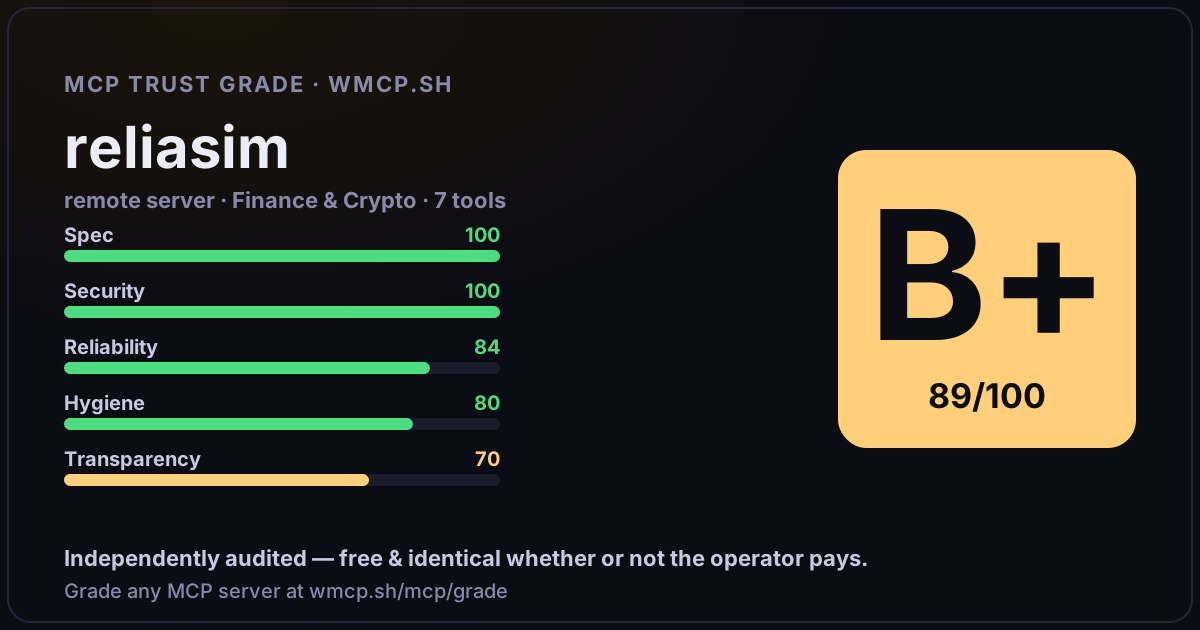
Share this report card
A 1200×630 card with the grade + audit — drop it in a post, Slack, or your repo.
Embed this grade
A live badge — it re-verifies itself and shows current stability. Static scorecards can't. Paste it in your README or site to show users you're independently audited.

[](https://wmcp.sh/mcp/grade/reliasim.com)
<a href="https://wmcp.sh/mcp/grade/reliasim.com"><img src="https://wmcp.sh/mcp/grade/reliasim.com/badge.svg" alt="MCP Trust Grade B+ · wmcp.sh"></a>
Agents: check this before connecting
Add the wmcp.sh trust oracle as an MCP server and call grade_mcp_server / check_mcp_drift in your agent's pre-connection gate:
https://wmcp.sh/mcp/trust
readOnly vs observed behavior) layer on via the wmcp.sh proxy.