A

npm:japan-ux-mcp

https://www.npmjs.com/package/japan-ux-mcp
93/100 · MCP Trust Grade · checked 5h ago · MCP 1.0.3

What it offers — 10 tools · Developer Tools

generate_jp_form

Generate culturally correct Japanese form markup with proper field order (姓→名), furigana, 3-field phone, 〒 postal address, 年月日 dates, and context-appr

validate_jp_form

Audit an existing form against Japanese UX conventions. Checks for: name field order (姓/名), furigana, 3-field phone, postal code auto-fill, keigo-appr

generate_jp_placeholder

Generate realistic Japanese test data for prototypes and development. Returns names (kanji + katakana furigana + romaji), addresses (real postal codes

suggest_keigo_level

Suggest appropriately polite Japanese UI text based on context. Maps business context to keigo level (casual → very_formal) and returns the right Japa

score_japan_readiness

Score any page or component for Japan-readiness on a 0-100 scale. Analyzes 5 categories: forms (name order, furigana, phone, postal), copy (keigo, Jap

transform_for_japan

Transform Western markup into Japan-ready markup. Automatically fixes: name field order (firstName/lastName → 姓/名), adds furigana, splits phone into 3

check_jp_typography

Audit CSS and markup for Japanese typography issues. Checks: font stacks (Noto Sans JP, Hiragino, Yu Gothic), line-height (1.8+ for Japanese), font si

get_seasonal_context

Get the current Japanese seasonal context for design decisions. Returns: current season with traditional colors, active events (正月, 花見, お盆, etc.), upc

audit_japan_ux

Comprehensive Japanese UX audit covering 7 categories: layout (density, breadcrumbs, CTA placement), typography (fonts, line-height, kinsoku shori), v

design_direction_for_japan

Generate a Japan-specific visual direction for a website or interface. Takes a loose brand type, audience, and industry, then returns a practical desi

Spec / packaging20%100
Security (OWASP MCP)30%90
Maintenance / popularity20%92
Tool hygiene15%95
Transparency / provenance15%90

Findings

INFO Static analysis of npm package japan-ux-mcp@1.0.3 (stdio server — no remote endpoint). Reliability/behavioral signals require running it; not measured.
Grade another server

We re-grade npm:japan-ux-mcp on a schedule and alert your Slack/webhook the moment its tools change or its grade drops — rug-pull insurance for the connection.

Share this report card

A 1200×630 card with the grade + audit — drop it in a post, Slack, or your repo.
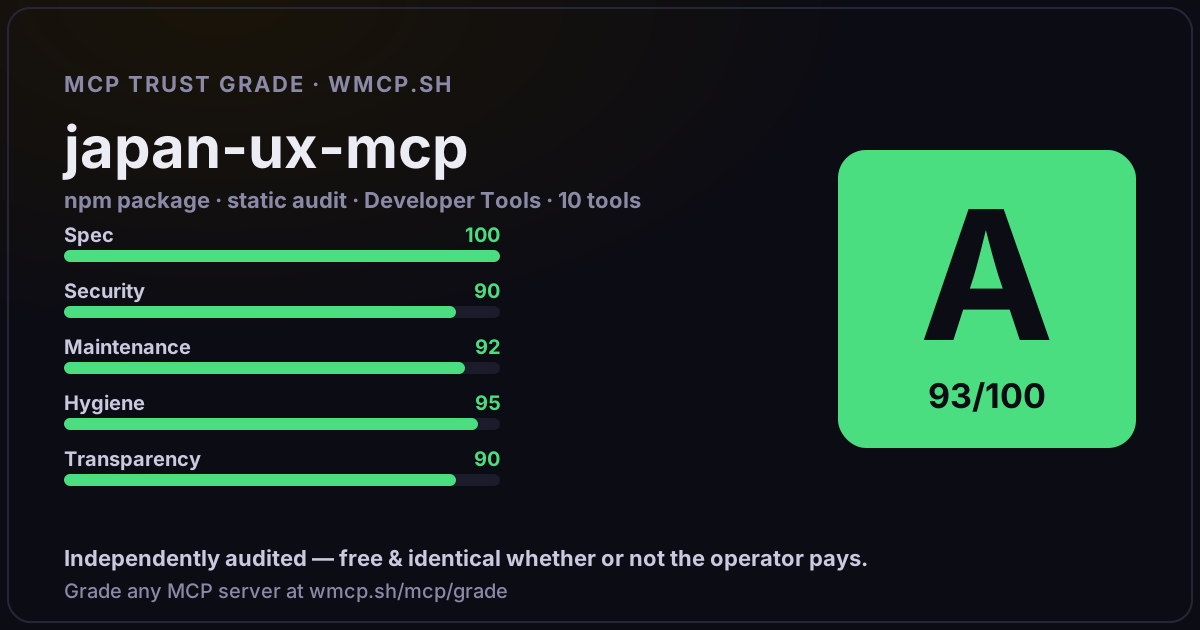
MCP Trust report card — npm:japan-ux-mcp grade A
Share on X Open card image

Embed this grade

A live badge — it re-verifies itself and shows current stability. Static scorecards can't. Paste it in your README or site to show users you're independently audited.

MCP Trust Grade A · wmcp.sh
[![MCP Trust Grade A](https://wmcp.sh/mcp/grade/npm%3Ajapan-ux-mcp/badge.svg)](https://wmcp.sh/mcp/grade/npm%3Ajapan-ux-mcp)
<a href="https://wmcp.sh/mcp/grade/npm%3Ajapan-ux-mcp"><img src="https://wmcp.sh/mcp/grade/npm%3Ajapan-ux-mcp/badge.svg" alt="MCP Trust Grade A · wmcp.sh"></a>

Agents: check this before connecting

Add the wmcp.sh trust oracle as an MCP server and call grade_mcp_server / check_mcp_drift in your agent's pre-connection gate:

https://wmcp.sh/mcp/trust
How this grade is computed. An open, independent rubric — Spec conformance (20%), Security mapped to the OWASP MCP Top 10 (30%), Reliability (20%), Tool hygiene (15%), Transparency (15%) — run by connecting to the server and inspecting its real MCP surface. The grade is free and identical whether or not the operator pays. v1 uses static + spec signals from a single connection; continuous uptime, real latency, and annotation-truthing (declared readOnly vs observed behavior) layer on via the wmcp.sh proxy.
