npm:@quantrisk/mcp-server
Is the npm:@quantrisk/mcp-server MCP server safe to use?
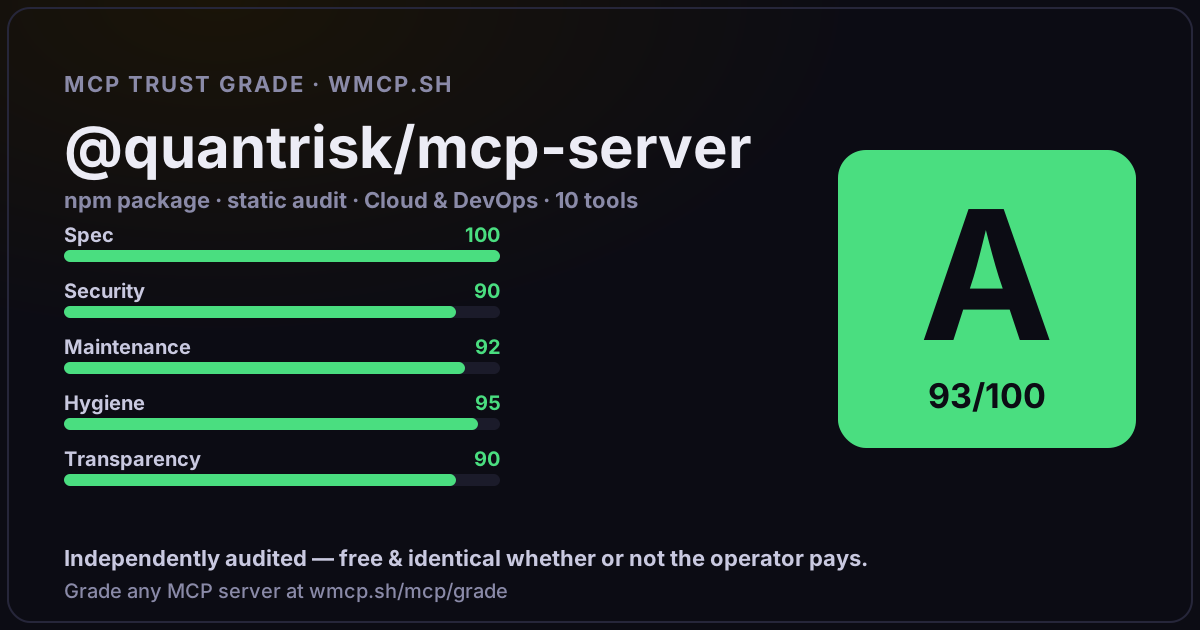
Independent trust grade A (93/100). Static analysis of npm package @quantrisk/mcp-server@1.0.3 (stdio server — no remote endpoint). Reliability/behavioral signals require running it; not measured. wmcp.sh continuously watches npm:@quantrisk/mcp-server for tool drift and rug-pulls. The grade is free and identical whether or not the operator pays.
What it offers — 10 tools · Cloud & DevOps
analyze_riskCalculate core risk metrics for a portfolio — Value at Risk (VaR), Conditional VaR (CVaR), volatility, beta, and max drawdown.
monte_carlo_simulationRun Monte Carlo simulation on a portfolio to model the distribution of future returns, including percentile outcomes and probability of loss.
stress_testStress test a portfolio against historical crisis scenarios (GFC 2008, COVID 2020, etc.) or custom shocks (paid tier).
optimize_portfolioFind the optimal portfolio allocation using mean-variance optimization. Supports max Sharpe, min variance, and target return objectives. Paid tier onl
correlation_matrixCompute the pairwise correlation matrix for a set of assets. Identifies highly correlated pairs and diversification opportunities.
performance_attributionBreak down portfolio performance into factor exposures, sector allocation, and position contributions. Computes Sharpe, Sortino, Treynor, Calmar, and
sector_exposureBreak down portfolio exposure by GICS sector, market cap, and asset class. Returns concentration metrics including the Herfindahl-Hirschman Index.
price_historyFetch historical OHLCV price data for one or more tickers. Free tier: 1 ticker, 252 days. Paid tier: up to 20 tickers, 1260 days.
compare_portfoliosCompare two or more portfolio allocations head-to-head across all key risk and return metrics. Paid tier only.
calculate_greeksCalculate option Greeks (delta, gamma, theta, vega, rho) for individual options or an options portfolio. Uses Black-Scholes for European, binomial for
- ✓ depends on an MCP SDK
- ✓ declares a bin entry (runnable server)
- ✓ 10 tool(s) detected in source
- no high-risk patterns in sampled source
- scanned 6 source files
- published within 90 days
- 3 published versions
- ✓ ships TypeScript types
- 5 runtime deps
- ✓ public repository linked
- ✓ MIT license
- 211 weekly downloads
Findings
We re-grade npm:@quantrisk/mcp-server on a schedule and alert your Slack/webhook the moment its tools change or its grade drops — rug-pull insurance for the connection.
Share this report card
A 1200×630 card with the grade + audit — drop it in a post, Slack, or your repo.
Embed this grade
A live badge — it re-verifies itself and shows current stability. Static scorecards can't. Paste it in your README or site to show users you're independently audited.

[](https://wmcp.sh/mcp/grade/npm%3A%40quantrisk%2Fmcp-server)
<a href="https://wmcp.sh/mcp/grade/npm%3A%40quantrisk%2Fmcp-server"><img src="https://wmcp.sh/mcp/grade/npm%3A%40quantrisk%2Fmcp-server/badge.svg" alt="MCP Trust Grade A · wmcp.sh"></a>
Agents: check this before connecting
Add the wmcp.sh trust oracle as an MCP server and call grade_mcp_server / check_mcp_drift in your agent's pre-connection gate:
https://wmcp.sh/mcp/trust
readOnly vs observed behavior) layer on via the wmcp.sh proxy.