mcp.sipflow.dev
What it offers — 22 tools · Developer Tools
search_sip_docs[cost: rag (one embed + one vector search) | read-only, network: outbound to embed model only] Vector search over Sipflow's curated VoIP knowledge bas
lookup_response_code[cost: free (pure CPU, no network) | read-only] Instant static lookup of a SIP response code (100-699). Returns name, RFC anchor, category, descriptio
lookup_sip_header[cost: free (pure CPU, no network) | read-only] Instant lookup of a SIP header by canonical or compact form (e.g. "Via" / "v", "Diversion", "P-Asserte
detect_sip_stack[cost: free (pure CPU, no network) | read-only] Identify the SIP product behind a piece of input. Works on both: - a SIP trace (User-Agent / Server he
detect_sip_vendor_from_config[cost: free (pure CPU, no network) | read-only] Heuristic-only sibling of `detect_sip_stack`, scoped to vendor configs. Returns the matched vendor slu
minimize_sip_trace[cost: free (pure CPU, no network) | read-only, no persistence] Reduce a raw SIP trace to a compact form suitable for sending to an LLM. Preserves SDP
render_sip_ladder[cost: free (pure CPU, no network) | read-only] Parse a raw SIP trace (PCAP-decoded text, sngrep export, syslog, or pasted INVITE/200 dialog) and emit
sip_ladder_example[cost: free (pure CPU, no network) | read-only] Return a hand-curated SIP scenario as a Mermaid `sequenceDiagram` plus a bullet list of step-by-step e
lint_sip_request[cost: free (pure CPU, no network) | read-only, no persistence] Run RFC 3261 / RFC 3325 / RFC 8224 / RFC 8225 / CTIA BCID compliance checks on a singl
parse_sip_message[cost: free (pure CPU, no network) | read-only, no persistence] Parse a single raw SIP message (request OR response) and return a structured view: sta
diff_sip_messages[cost: free (pure CPU, no network) | read-only, no persistence] Take two SIP messages (typically the same request observed at two adjacent hops - e.g.
review_sip_config[cost: free (pure CPU, no network) | read-only] Use this when the user asks 'review my config' or attaches a kamailio.cfg, sip.conf, pjsip.conf, FreeS
webrtc_sip_checklist[cost: free (pure CPU, no network) | read-only] Return a curated checklist of WebRTC ↔ SIP requirements (WSS transport, ICE gathering, DTLS-SRTP finge
parse_sdp[cost: free (pure CPU, no network) | read-only] Parse a Session Description Protocol body and return a structured view: origin, session, timing, per-m
compare_sdp_offer_answer[cost: free (pure CPU, no network) | read-only] Diff a SIP/SDP offer and answer and surface the issues that actually break calls in practice: codec in
validate_stir_shaken_identity[cost: external_io (HTTPS fetch of the x5u cert) | read-only] Verify a SIP `Identity:` JWS (RFC 8224 / SHAKEN). Fetches the x5u certificate, parses it
stir_attestation_explainer[cost: free (pure CPU, no network) | read-only] Static explainer for STIR/SHAKEN: maps attestation levels (A / B / C per RFC 8588) to plain-English re
validate_e164_number[cost: free (pure CPU, no network) | read-only] Parse a phone number, normalize to E.164, and classify it. International coverage is via libphonenumbe
+4 more tools
- ✓ initialize → protocolVersion 2025-06-18
- ✓ initialize HTTP 200
- ✓ unknown method → -32601
- ✓ tools/list → 22 tools
- ✓ every tool has name + inputSchema
- 22 tools scanned
- no injection markup
- no secret-path refs
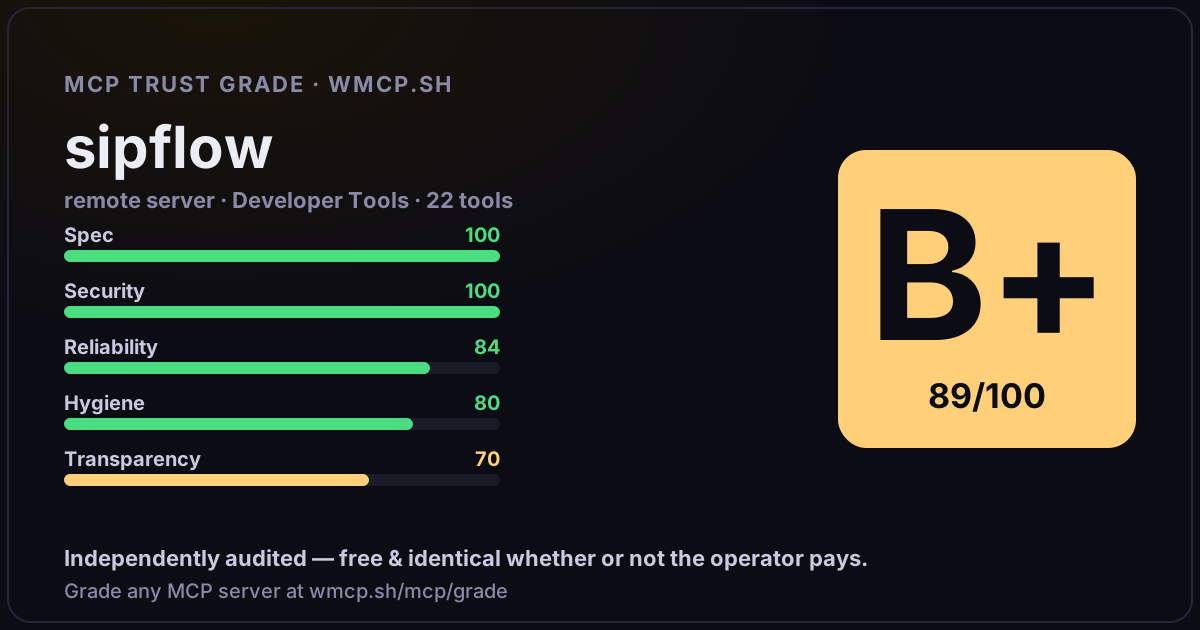
- single-probe latency 601ms (PRELIMINARY — continuous uptime/p95 from proxy telemetry lands in v2)
- 100% of tools have typed inputSchema
- 0/22 declare outputSchema
- no unannotated destructive tools
- HTTPS ✓
- advertises protocol 2025-06-18
Observed behavior
No proxied traffic observed for this host yet. Connect it at /connect and its grade gains a measured Reliability score + per-tool behavioral evidence — the half a static scan can't produce.
Findings
We re-grade mcp.sipflow.dev on a schedule and alert your Slack/webhook the moment its tools change or its grade drops — rug-pull insurance for the connection.
Share this report card
A 1200×630 card with the grade + audit — drop it in a post, Slack, or your repo.
Embed this grade
A live badge — it re-verifies itself and shows current stability. Static scorecards can't. Paste it in your README or site to show users you're independently audited.

[](https://wmcp.sh/mcp/grade/mcp.sipflow.dev)
<a href="https://wmcp.sh/mcp/grade/mcp.sipflow.dev"><img src="https://wmcp.sh/mcp/grade/mcp.sipflow.dev/badge.svg" alt="MCP Trust Grade B+ · wmcp.sh"></a>
Agents: check this before connecting
Add the wmcp.sh trust oracle as an MCP server and call grade_mcp_server / check_mcp_drift in your agent's pre-connection gate:
https://wmcp.sh/mcp/trust
readOnly vs observed behavior) layer on via the wmcp.sh proxy.