discreterate.com
What it offers — 9 tools · Other
run_fast_slow_drainRun the Fast-Slow Drain (FSD) demo — Damiron-Nastasi 2008 oscillating tank. The canonical DRS-vs-DES event-count demonstration. Returns engine output
run_hamburger_duoRun the Hamburger Duo (HAM) demo — Andy Siprelle's 5-stage finite-source line, executed as both DES and DRS implementations on the same model so the e
run_valdez_tankerRun the Valdez Tanker (VALD) demo — Koelling-Remy 1983 Alaska Pipeline model, the paradigm-integration motivator. Crude flows continuously into the Va
list_drs_demosList the three canonical DRS demos (Fast-Slow Drain · Hamburger Duo · Valdez Tanker). Each demo is documented in academic literature and reproducible
describe_demoFull per-demo write-up: history, what it teaches, what to expect from the run_* output. Use this to ground the user before triggering a sim run, or to
explain_discrete_rate_simulationReturn a textbook-tier explainer of Discrete Rate Simulation: how it differs from DES and CT, the three primitives (Constraint / Buffer / Interrupt),
explain_three_primitivesReturn a focused write-up of the three DRS modeling primitives: Constraint (rate-limiter), Buffer (accumulated state), Interrupt (stoppage). Use this
explain_paradigm_integrationReturn an explainer of paradigm integration — how DRS handles systems with both flows and items via F2I (Flow-to-Item) and I2F (Item-to-Flow) primitiv
explain_des_vs_drs_event_complexityReturn a focused write-up of the event-count complexity differences between DES and DRS, with the worked Fast-Slow Drain numbers (Continuous ~thousand
- ✓ initialize → protocolVersion 2025-06-18
- ✓ initialize HTTP 200
- ✓ unknown method → -32601
- ✓ tools/list → 9 tools
- ✓ every tool has name + inputSchema
- 9 tools scanned
- no injection markup
- no secret-path refs
- single-probe latency 3590ms (PRELIMINARY — continuous uptime/p95 from proxy telemetry lands in v2)
- 44% of tools have typed inputSchema
- 0/9 declare outputSchema
- no unannotated destructive tools
- HTTPS ✓
- advertises protocol 2025-06-18
Observed behavior
No proxied traffic observed for this host yet. Connect it at /connect and its grade gains a measured Reliability score + per-tool behavioral evidence — the half a static scan can't produce.
Findings
We re-grade discreterate.com on a schedule and alert your Slack/webhook the moment its tools change or its grade drops — rug-pull insurance for the connection.
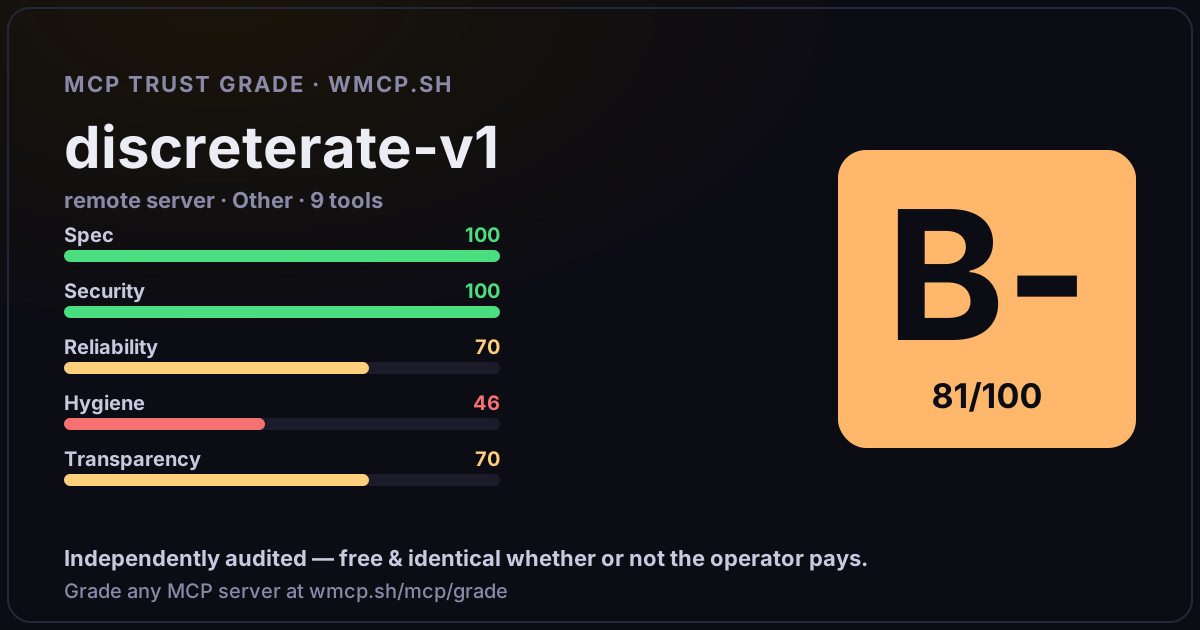
Share this report card
A 1200×630 card with the grade + audit — drop it in a post, Slack, or your repo.
Embed this grade
A live badge — it re-verifies itself and shows current stability. Static scorecards can't. Paste it in your README or site to show users you're independently audited.

[](https://wmcp.sh/mcp/grade/discreterate.com)
<a href="https://wmcp.sh/mcp/grade/discreterate.com"><img src="https://wmcp.sh/mcp/grade/discreterate.com/badge.svg" alt="MCP Trust Grade B- · wmcp.sh"></a>
Agents: check this before connecting
Add the wmcp.sh trust oracle as an MCP server and call grade_mcp_server / check_mcp_drift in your agent's pre-connection gate:
https://wmcp.sh/mcp/trust
readOnly vs observed behavior) layer on via the wmcp.sh proxy.