api.codeitall.dev
What it offers — 7 tools · Database
answer_api_questionUse this when an agent asks open-ended Rust API questions like 'how do I parse a duration string', 'which crate gives me HMAC verification', 'is this
signature_searchUse when the agent already knows the signature shape it wants — e.g. `fn(&str) -> Result<Vec<u8>, _>`, `fn(&[u8]) -> Result<String, std::str::Utf8Erro
behavior_lookupUse when the agent has a specific (crate, fn_name) pair and wants to know what inputs it actually accepts at runtime — e.g. `(crate='jiff', fn_name='T
compare_implementationsUse when the agent asks about a task category — e.g. 'how do I parse JSON in rust', 'compare base64 crates', 'which datetime library handles RFC 3339
find_modern_equivalentUse when the agent suspects the code it's about to write uses a deprecated API — e.g. `tokio::Runtime::new()` (now `tokio::runtime::Runtime::new()`),
list_familiesUse when the agent wants to enumerate the probe families codeitall has covered — typically before constructing a `compare_implementations(task=…)` cal
pattern_consensusUse when the agent wants the cross-project CONSENSUS — 'how do most current Next.js projects actually do X?' — rather than a single example. Returns p
- ✓ initialize → protocolVersion 2024-11-05
- ✓ initialize HTTP 200
- ✓ unknown method → -32601
- ✓ tools/list → 7 tools
- ✓ every tool has name + inputSchema
- 7 tools scanned
- no injection markup
- no secret-path refs
- single-probe latency 2630ms (PRELIMINARY — continuous uptime/p95 from proxy telemetry lands in v2)
- 100% of tools have typed inputSchema
- 0/7 declare outputSchema
- no unannotated destructive tools
- HTTPS ✓
- advertises protocol 2024-11-05
Observed behavior
No proxied traffic observed for this host yet. Connect it at /connect and its grade gains a measured Reliability score + per-tool behavioral evidence — the half a static scan can't produce.
Findings
We re-grade api.codeitall.dev on a schedule and alert your Slack/webhook the moment its tools change or its grade drops — rug-pull insurance for the connection.
Share this report card
A 1200×630 card with the grade + audit — drop it in a post, Slack, or your repo.
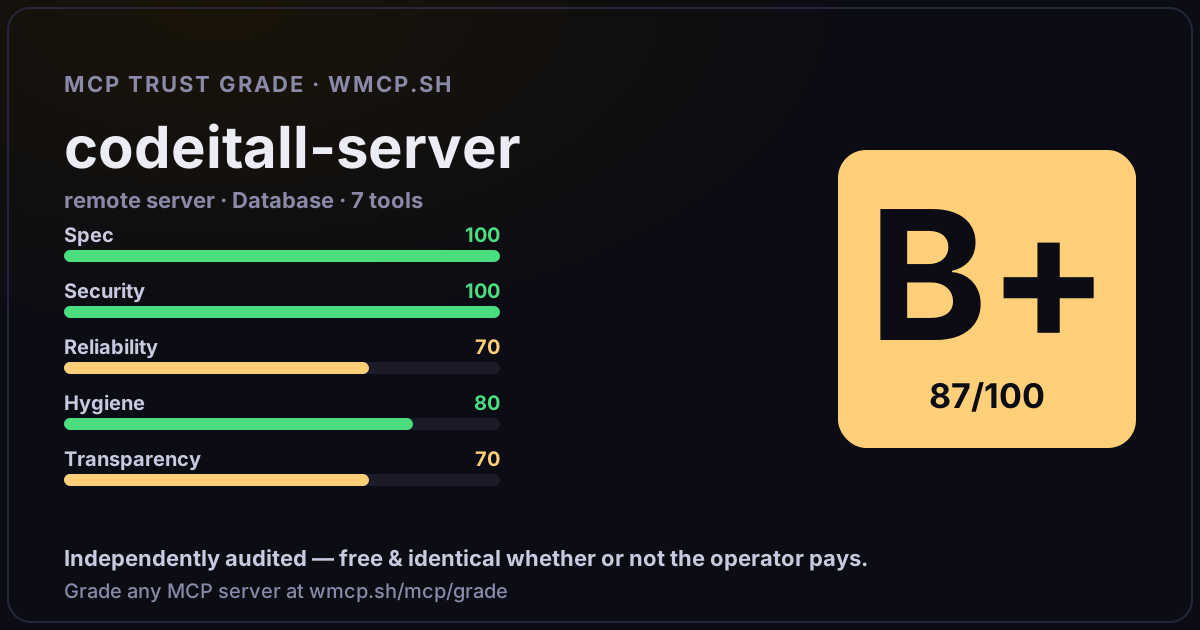
Embed this grade
A live badge — it re-verifies itself and shows current stability. Static scorecards can't. Paste it in your README or site to show users you're independently audited.

[](https://wmcp.sh/mcp/grade/api.codeitall.dev)
<a href="https://wmcp.sh/mcp/grade/api.codeitall.dev"><img src="https://wmcp.sh/mcp/grade/api.codeitall.dev/badge.svg" alt="MCP Trust Grade B+ · wmcp.sh"></a>
Agents: check this before connecting
Add the wmcp.sh trust oracle as an MCP server and call grade_mcp_server / check_mcp_drift in your agent's pre-connection gate:
https://wmcp.sh/mcp/trust
readOnly vs observed behavior) layer on via the wmcp.sh proxy.